AudioQuest

Audioquest DragonFly Copper USB DAC

Skip to product information
1 of 4

DRAGONFLY COPPER

Regular price $345.00
Sale price $345.00 Regular price

Free Shipping

  • In Stock

(For store pickups, please call for availability.)


Product Overview

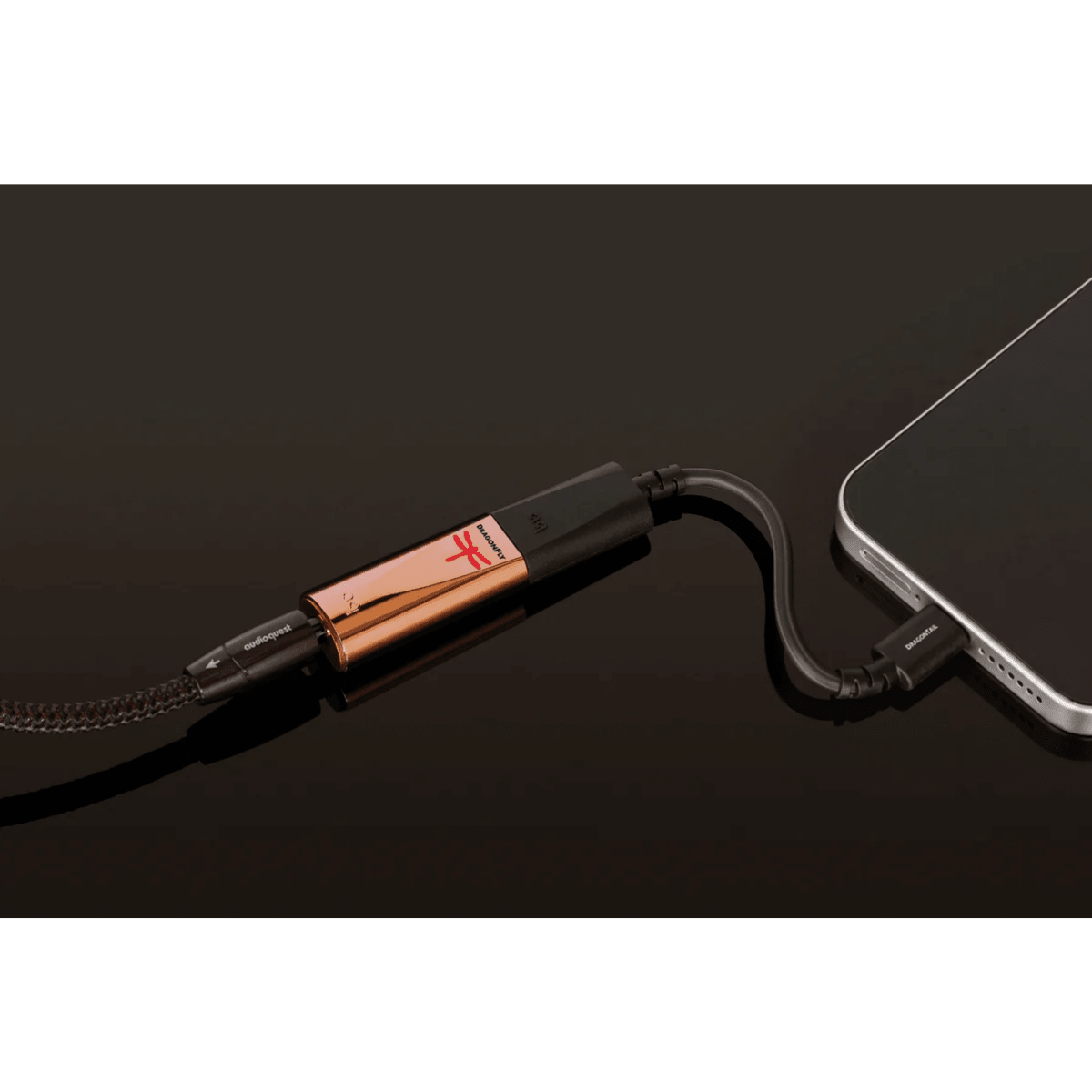
The AudioQuest DragonFly Copper is a portable USB DAC, preamplifier, and headphone amplifier that bypasses the audio circuitry in laptops, computers, and smartphones to deliver cleaner, more natural sound to headphones, powered speakers, or a complete audio system. The most advanced DragonFly to date, it features a 32-bit ESS Sabre DAC chip, a copper-plated RF-draining case, and twice the output power of any previous DragonFly model.

Features

  • 32-bit ESS Sabre DAC for high-resolution playback from MP3 to Hi-Res audio
  • Compatible with Apple and Windows PCs, iOS and Android devices
  • Drives headphones and feeds preamps, amplifiers, and powered speakers
  • Volume controlled by phone, tablet, or computer
  • Meets all USB Audio Class standards — no additional drivers required
  • DragonFly emblem changes colour to indicate sampling rate: red (standby), green (44.1kHz), blue (48kHz), yellow (88.2kHz), light blue (96kHz)
  • Includes DragonTail USB-A to USB-C adaptor
  • Travel-friendly dimensions: 19mm W x 12mm H x 57mm L

Compared to Previous DragonFly Models

  • 2x greater output power
  • 25% lower current draw
  • High-conductivity copper-plated case for improved RF-noise drainage
  • Distortion reduced significantly below previous models

Specifications

DAC Chip — 32-bit ESS Sabre ES9218

Output — 2.1 volts

Mobile Compatibility — Apple iOS, Android

Desktop Compatibility — Windows, Apple, Linux (no technical support provided)

Volume Control — Phone, tablet, or computer controls the output level

Included Accessories — DragonTail A to C Adaptor

Frequently Asked Questions

What is the AudioQuest DragonFly Copper?

The AudioQuest DragonFly Copper is a portable USB DAC, preamplifier, and headphone amplifier that bypasses the built-in audio circuitry of laptops, computers, and smartphones to deliver cleaner, more detailed sound to headphones, powered speakers, or a complete audio system. Built around a 32-bit ESS Sabre ES9218 integrated DAC and headphone amplifier chip, it is AudioQuest's most powerful and efficient DragonFly to date, delivering twice the headphone output power and drawing 25% less current than any previous model. The AudioQuest DragonFly Copper is available at Trutone Electronics in Mississauga, Ontario.

What changed between the AudioQuest DragonFly Cobalt and the DragonFly Copper?

The AudioQuest DragonFly Copper is the most significant generational upgrade since the Cobalt launched in 2019, with changes spanning the DAC chip, headphone amplifier, power efficiency, and noise management. The Cobalt used an ESS ES9038Q2M DAC paired with a separate ESS 9601 headphone amplifier; the Copper replaces both with an integrated ESS ES9218 that delivers twice the headphone output power while drawing 25% less current. The Copper also replaces the Cobalt's internal RF filtering with a high-conductivity copper-plated case that drains induced RF energy away from the audio circuitry, and MQA support has been deliberately removed given that TIDAL dropped MQA in July 2024 and now streams standard FLAC.

What DAC chip does the AudioQuest DragonFly Copper use and why was it chosen?

The AudioQuest DragonFly Copper uses a 32-bit ESS Sabre ES9218, an integrated circuit combining the DAC and headphone amplifier into a single component, replacing the separate ESS chips used in the Cobalt. This architecture allowed AudioQuest to deliver twice the amplification of any previous DragonFly while simultaneously reducing current draw and lowering distortion to its lowest level across the entire DragonFly lineup. The same digital filter options available in the Cobalt carry over to the ES9218, preserving the sonic character of the DragonFly family while improving measured performance.

Why does the AudioQuest DragonFly Copper only support up to 24-bit/96kHz?

The AudioQuest DragonFly Copper's 24-bit/96kHz ceiling is a deliberate engineering decision rooted in power efficiency rather than a cost or component limitation. Full Speed USB, which tops out at 24-bit/96kHz, draws dramatically less power than High Speed USB, which competing dongles use to reach 32-bit/384kHz, and which can draw between two and ten times more current. Because a significant portion of DragonFly users listen via smartphones, AudioQuest prioritised a design that improves battery life rather than chasing specification numbers that offer little audible benefit in real-world conditions.

Does the AudioQuest DragonFly Copper support MQA?

The AudioQuest DragonFly Copper does not support MQA. AudioQuest made a deliberate choice to remove MQA rendering from the Copper, in contrast to the DragonFly Cobalt which included it. Removing MQA reduced DSP processing requirements, freeing resources for the increased headphone output power and lower distortion that define the Copper's improvements. For most users this omission has little practical consequence as TIDAL removed all MQA content from its library in July 2024 and now delivers high-resolution audio in standard FLAC format.

What is the purpose of the AudioQuest DragonFly Copper's copper-plated case?

The copper-plated case of the AudioQuest DragonFly Copper is a functional noise-management component, not simply an aesthetic choice. Direct-plated copper is more effective at draining induced RF energy than polymer, brass, zinc, or aluminum — materials commonly used in competing USB DACs — and in a device sitting millimetres from the RF-noisy internals of a laptop or smartphone, this drainage path actively reduces the noise floor at the audio circuitry. AudioQuest describes the DragonFly Copper as its quietest DragonFly to date.

What devices is the AudioQuest DragonFly Copper compatible with?

The AudioQuest DragonFly Copper is compatible with Windows and macOS computers, Apple iOS devices, and Android smartphones and tablets that support USB Host Mode. On computers it is plug-and-play with no additional drivers required, meeting all USB Audio Class standards. For USB-C devices the included DragonTail USB-A to USB-C adaptor connects directly; for older Apple devices with Lightning ports, Apple's Lightning to USB 3 Camera Adapter is required and purchased separately.

How is the sound of the AudioQuest DragonFly Copper described?

The AudioQuest DragonFly Copper is characterised by reviewers as warm, natural, and musically engaging, with a tuning that prioritises listening enjoyment. Its strongest performance is in its natural, well-separated midrange and full, weighty bass, while the treble is intentionally smooth and fatigue-free. AudioQuest's engineering team identifies more gain, stronger low-frequency grip, greater microdynamic expression, and more resolution as the key sonic gains over the Cobalt.

How does the AudioQuest DragonFly Copper work with a hi-fi system?

The AudioQuest DragonFly Copper operates as a variable-output headphone DAC with volume controlled by the connected device, or in fixed-output mode feeding a preamplifier or integrated amplifier's line input at 2.1 volts — the same output level as a CD player. This makes it a straightforward way to add a high-quality computer or phone source to an existing hi-fi system without a separate DAC component. The increased output power over the Cobalt also makes it a more capable partner for a wider range of headphones.

Who is the AudioQuest DragonFly Copper best suited for?

The AudioQuest DragonFly Copper is best suited for listeners who want an immediate upgrade to the audio quality from their laptop, computer, or smartphone without the complexity or size of a dedicated desktop DAC. Its plug-and-play simplicity, broad platform compatibility, and improved headphone amplification make it a strong choice for frequent travellers, headphone listeners using IEMs or low-to-moderate impedance headphones, and anyone using a computer as their primary music source. Buyers who specifically need MQA rendering, balanced output, DSD support, or very high output power for demanding over-ear headphones should consider alternatives better matched to those requirements.